⏱ 7 min read
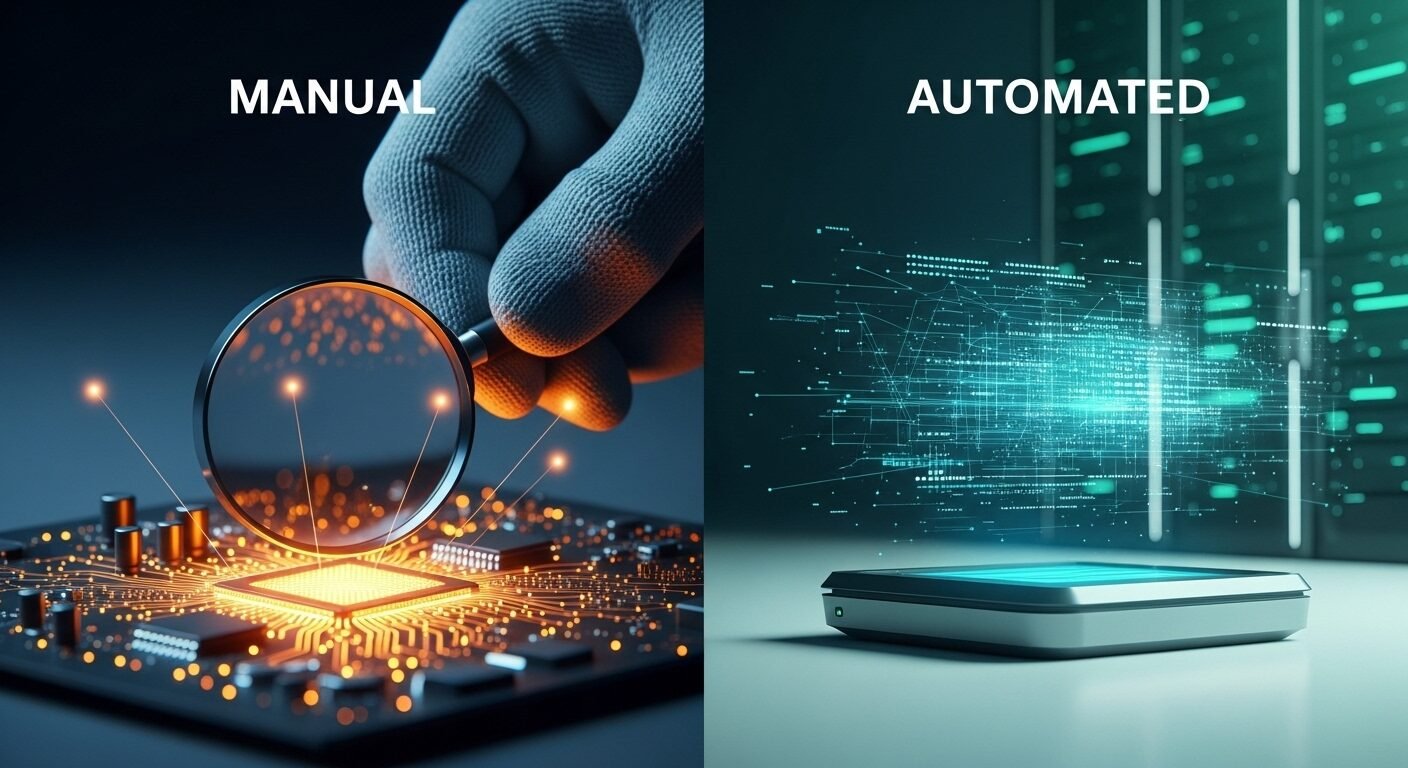
Securing server infrastructure requires a strategic blend of human expertise and technological efficiency. This article examines the fundamental differences between manual security audits performed by cybersecurity professionals and automated vulnerability scanners. We explore how each approach identifies risks, ensures compliance, and protects critical assets, ultimately advocating for an integrated methodology that leverages the depth of manual analysis with the breadth and speed of automation for comprehensive server protection.

Key Takeaways
- Manual audits provide deep, contextual analysis that automated tools often miss.
- Automated scanners offer speed, consistency, and broad coverage for known vulnerabilities.
- A hybrid approach is essential for meeting strict compliance standards like PCI DSS and HIPAA.
- Manual testing is critical for uncovering complex logic flaws and business logic errors.
- Automation excels at continuous monitoring and scaling security across large infrastructures.
- The optimal strategy combines both methods based on risk, resources, and regulatory requirements.
What Are Manual and Automated Security Audits?
A manual security audit involves cybersecurity experts systematically examining systems, code, and configurations for vulnerabilities. An automated security audit uses software tools to scan infrastructure against databases of known threats. The core distinction lies in human judgment versus programmed detection.
Manual security assessments, often conducted by certified ethical hackers or penetration testers, involve a human-driven process of discovery, exploitation, and analysis. These professionals simulate real-world attacks, thinking creatively to bypass defenses. This human-centric approach is unparalleled for uncovering novel attack vectors and complex chained vulnerabilities. Experts recommend manual testing for critical systems, as it provides the contextual understanding that automated systems lack.
Automated vulnerability scanning, using tools like Nessus, OpenVAS, or Qualys, provides rapid, repeatable checks against thousands of known Common Vulnerabilities and Exposures (CVEs). According to industry data, these tools can scan entire networks in hours, identifying missing patches, misconfigurations, and weak credentials. They form the backbone of continuous security monitoring programs, especially for organizations with limited security staff.
When Should You Choose a Manual Security Audit?
You should choose a manual penetration test when dealing with custom applications, complex business logic, or after significant infrastructure changes. Manual analysis excels where context and creativity are required.
Manual testing is essential for uncovering vulnerabilities that automated scanners cannot detect. These include business logic flaws, where an application works as designed but allows unintended actions. For example, a scanner might verify a login page is secure, but a human tester could discover a flaw allowing privilege escalation after login.
Complex authentication and authorization schemes often require manual review. A human auditor can trace session management, token validation, and access control flows in ways automated tools struggle with. This is crucial for financial applications or systems handling sensitive personal data. The standard approach is to conduct manual audits annually or after major code deployments.
Custom-built software and proprietary systems benefit immensely from manual code review and testing. Automated tools rely on signatures for known issues, but custom code may contain unique vulnerabilities. Research shows that manual testing identifies 40% more critical vulnerabilities in custom web applications compared to automated scans alone.
What Are the Advantages of Automated Vulnerability Scanners?
Automated scanners provide speed, scalability, and consistency unmatched by manual processes. They are ideal for regular compliance checks and large-scale infrastructure assessments.
The primary advantage of automated security scanning is efficiency. Tools can assess thousands of systems simultaneously, providing immediate results. This allows for frequent testing, which is impossible with manual methods due to cost and time constraints. Automation enables continuous security posture monitoring, a fundamental requirement in modern DevOps environments.
Consistency and standardization are other key benefits. An automated tool performs the same checks every time, eliminating human error or oversight. This is vital for compliance reporting, where auditors need evidence of regular, consistent testing. Frameworks like the Center for Internet Security (CIS) Benchmarks are often verified using automated tools.
Automated scanners excel at identifying known vulnerabilities, misconfigurations, and missing patches. They maintain updated databases of Common Vulnerabilities and Exposures, ensuring new threats are detected quickly. For asset discovery and inventory management, automation is indispensable. Platforms like serveraudit.online leverage automation to provide ongoing visibility into server security states.
How to Implement a Balanced Audit Strategy
Implementing a balanced strategy involves using automated tools for breadth and manual testing for depth. Follow this structured approach to integrate both methodologies effectively.
Steps for a Hybrid Security Audit Program
- Asset Discovery and Inventory: Use automated tools to map your entire network, identifying all servers, devices, and applications. This creates the scope for all subsequent testing.
- Automated Vulnerability Scanning: Schedule regular scans (weekly or monthly) using tools configured for your environment. Address all critical and high-risk findings immediately.
- Targeted Manual Testing: Based on scan results and risk assessment, select high-value targets for manual penetration testing. Focus on external-facing applications and critical internal systems.
- Code Review for Custom Applications: Conduct manual or semi-automated code analysis for internally developed software, particularly before production deployment.
- Compliance Verification: Use automated checks for routine compliance requirements and manual audits for complex control validation, especially for standards like SOC 2.
- Continuous Improvement: Analyze findings from both methods to improve security policies, patch management processes, and developer training programs.
A balanced program allocates resources based on risk. High-risk systems receive both automated and manual attention. Medium-risk systems might get frequent automated scans with annual manual checks. Low-risk systems can be managed primarily through automation. This tiered approach maximizes security ROI.
Integration is key. Manual testers should review automated scan results to prioritize their efforts. Conversely, automation can be configured to check for vulnerabilities discovered during manual testing. This creates a virtuous cycle of improvement. Experts in the field recommend this integrated approach for organizations subject to regulatory requirements.
Compliance Requirements for Different Audit Methods
Different compliance frameworks mandate specific combinations of manual and automated testing. Understanding these requirements is crucial for passing audits.
Payment Card Industry Data Security Standard (PCI DSS) explicitly requires both automated vulnerability scanning (Requirement 11.2) and annual penetration testing (Requirement 11.3). The scanning must be performed quarterly by an Approved Scanning Vendor (ASV), while penetration testing must be conducted by qualified personnel. Failing to implement both methods will result in PCI DSS non-compliance.
Health Insurance Portability and Accountability Act (HIPAA) requires risk analysis, which typically involves automated scanning to identify vulnerabilities in systems containing Protected Health Information (PHI). Manual testing is often needed to assess the realistic impact of those vulnerabilities. The Department of Health and Human Services (HHS) emphasizes the importance of comprehensive testing.
Other frameworks have varying expectations. The National Institute of Standards and Technology (NIST) Cybersecurity Framework recommends continuous monitoring (automation) and periodic assessment (manual). International Organization for Standardization (ISO) 27001 requires a risk-based approach, often interpreted as using both methods. The table below summarizes key requirements.
| Compliance Framework | Automated Scanning Requirement | Manual Testing Requirement | Frequency |
|---|---|---|---|
| PCI DSS | Mandatory (Quarterly) | Mandatory (Annual) | Explicitly Defined |
| HIPAA | Implied via Risk Analysis | Recommended for High Risk | Ongoing |
| ISO 27001 | Recommended | Recommended | Risk-Based |
| SOC 2 | Common Practice | Common for Critical Systems | At least Annually |
For most organizations, a combination satisfies auditors. Automated tools provide the evidence of regular testing, while manual assessments demonstrate deeper due diligence. Always document the rationale for your testing methodology, especially if deviating from standard practices.
Frequently Asked Questions
Which is more cost-effective: manual or automated security audits?